Hide outline
Share Blog
Blog
Author:
Was this lesson helpful?
Dive Deeper
Generate a follow-up sub-lesson on any aspect of this topic
Learn how to pick the right project, structure your story, explain architecture clearly, own your decisions, handle probing follow-ups, avoid common mistakes, and prepare with a checklist for a project deep-dive interview.
Your project deep-dive round is the one interview where you control the material, so prepare it like you would any system design question. Interviewers use it to see how you think about real systems, and a well-structured walkthrough of your past projects answers that question better than any hypothetical design.
Five signals sit behind every question. Ownership is whether you drove outcomes or watched them happen. Depth is whether you understand the layers beneath your own component. Decisions are the choices you made and why. Impact is what changed for users or the business. Trade-offs show whether you knew what you gave up.
Interviewers probe until they find the edge of your knowledge. Reaching that edge is fine. Pretending it isn’t there is what costs you, so aim your preparation at honest depth rather than polish.
These five signals frame every follow-up you will get.
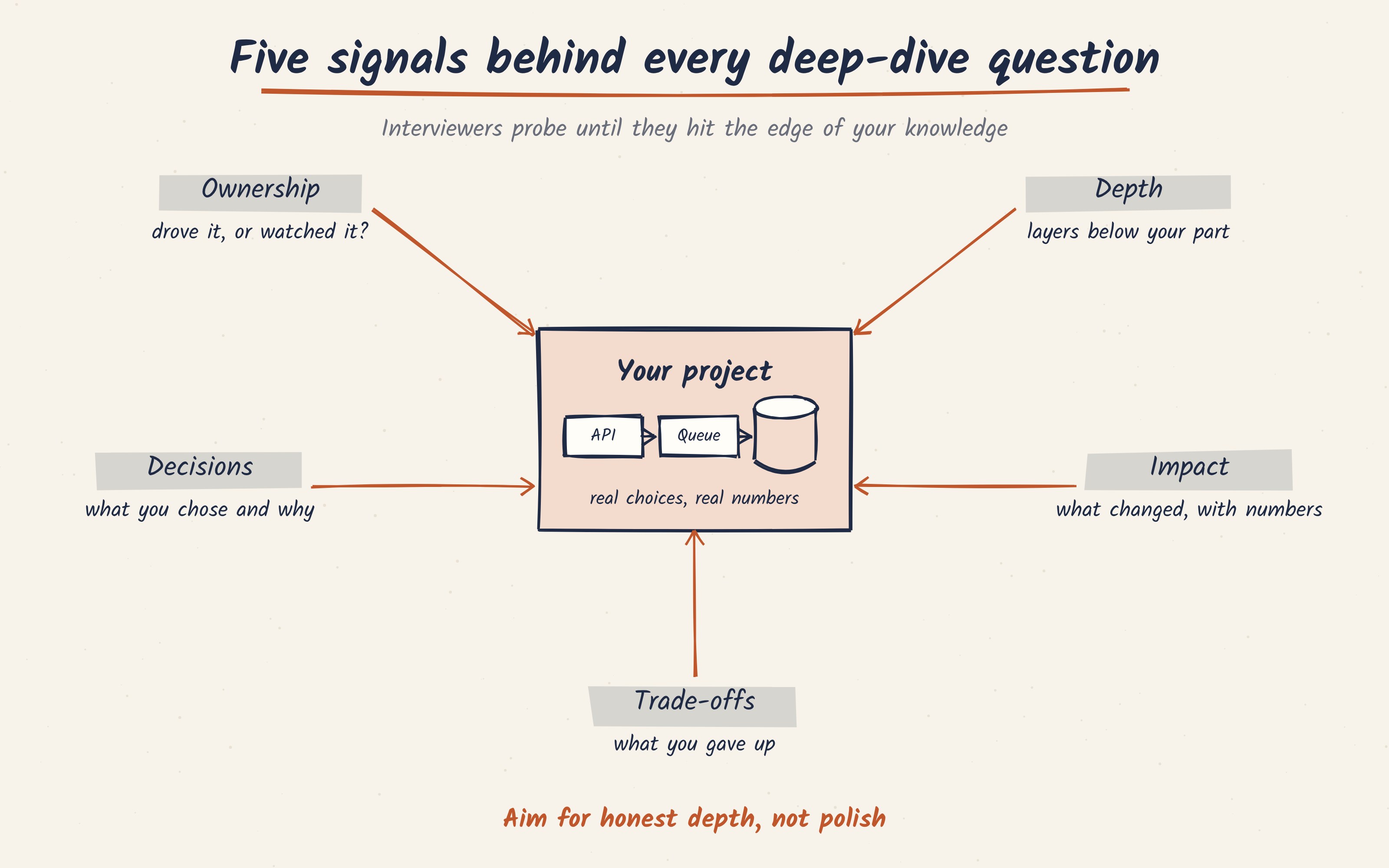
Interviewers listen for ownership, depth, decisions, impact, and trade-offs.
Pick a project with real scope, one where you made meaningful design choices rather than executing a ticket list. Your role should be easy to state in one sentence, and the complexity should be credible. A service handling modest traffic with thoughtful trade-offs beats an inflated one you can’t defend.
Walk through five beats in order. Start with context, meaning the problem, the users, and the constraints, in about two minutes. Move to the architecture at a high level, then to the two or three decisions that shaped it. Follow with failure modes, covering what broke or could break and how you handled it. Close with results.
Spending most of your time on decisions and failure modes is what separates a deep-dive from a tour. Anyone can list components. Few can explain why a queue replaced a synchronous call and what happened during the first incident afterward.
Decisions Carry the StoryGive decisions and failure modes more airtime than component lists. That is where depth becomes visible.
Here is how that airtime should be split across the five beats.
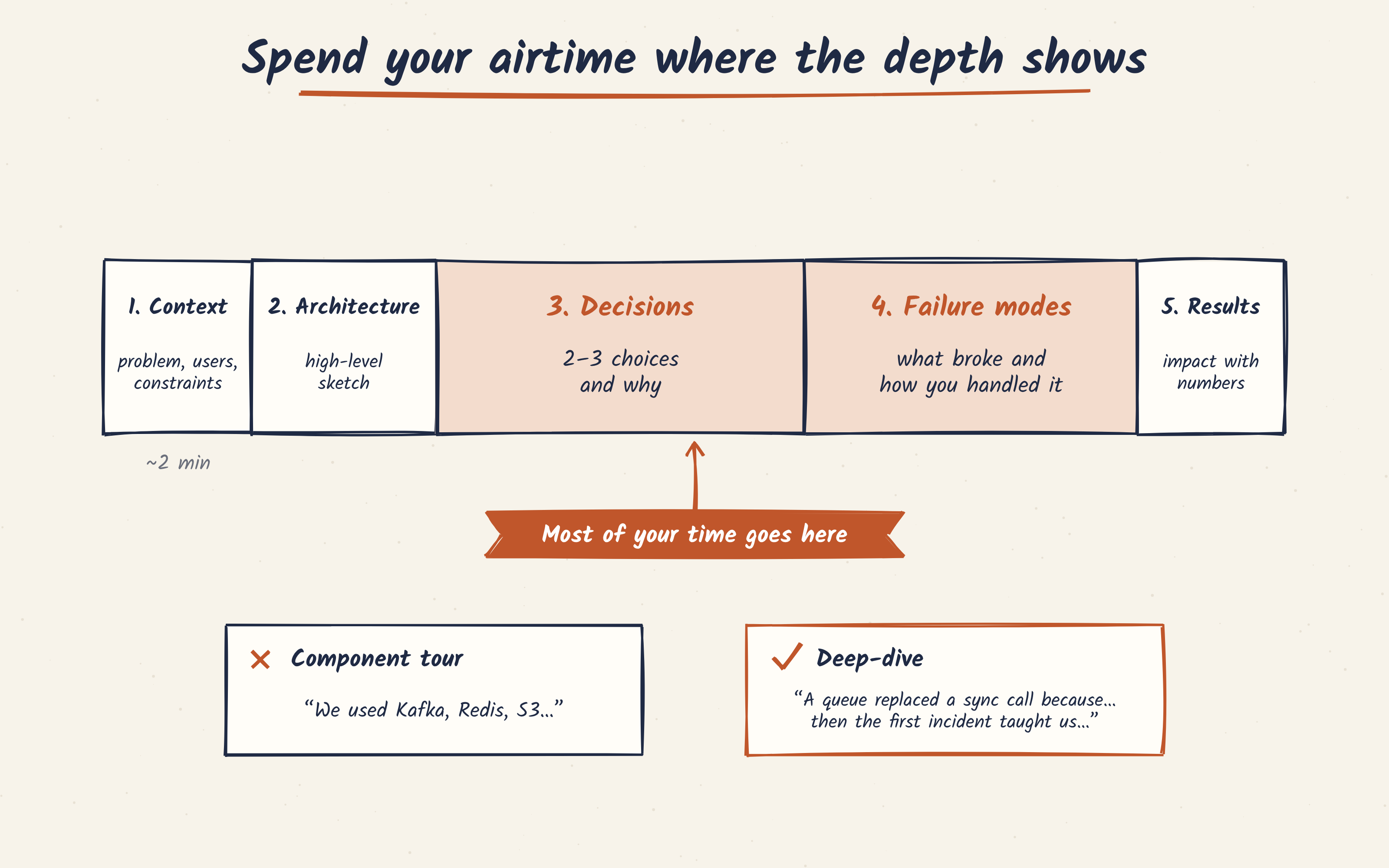
Spend most of your walkthrough on decisions and failure modes, not a component tour.
Sketch one simple diagram before you talk through it. Start at the highest zoom with clients, services, and data stores, then zoom into only the part the interviewer cares about. Announce your zoom level so they never wonder where you are.
Use crisp, consistent terminology. If you call something a gateway, don’t switch to proxy halfway through. Define internal names once, or replace them with generic terms, since the interviewer has never seen your codebase.
When asked why you chose something, give the rationale, the constraints at the time, and the alternative you rejected. Constraints such as team size, deadlines, or existing infrastructure often justify choices that look odd in hindsight, so say so plainly.
For areas you didn’t own, state that clearly and then share what you understood about them and how they affected your work. Something like “I didn’t build the billing pipeline, but our events fed it, so I know it needed idempotent consumers” shows awareness without overclaiming. If you don’t know, say so and reason aloud about what you would expect.
Use we for outcomes the team achieved and I for decisions and work you personally did. Blurring the two in either direction hurts you. Saying we throughout hides your contribution, and saying I throughout sounds unreliable once follow-ups reveal the team around you.
Claim credit responsibly by naming collaborators and what they contributed. Interviewers often read that as confidence, and it makes your own claims easier to trust.
Most of these come from the same root, which is preparing the story but not the evidence behind it.
Gather the artifacts first, such as old design docs, diagrams, dashboards, and incident reports, so your memory has something to anchor to. Write down your key numbers, including traffic, data size, latency, error rates, and costs, along with how each was measured.
Then rehearse out loud. Time the narrative, practice drawing the diagram from scratch, and ask a friend to interrupt with questions. Build a question bank covering why, what if it failed, what would you change, and what didn’t you own. Pick one project and run a full mock deep-dive this week, then fix whatever stalled you.