Hide outline
Share Blog
Blog
Author:
Was this lesson helpful?
Dive Deeper
Generate a follow-up sub-lesson on any aspect of this topic
The pH scale measures how acidic or basic a substance is on a 0 to 14 range. Learn what the numbers mean, how common items like lemon juice, coffee, and bleach rank, and how to use pH safely at home.
The pH scale is a number line from 0 to 14 that tells you how acidic or basic a liquid is. Lemon juice sits near 2, water near 7, and bleach near 13. That one number explains why vinegar cuts soap scum, why shampoo labels mention balance, and why a pool needs regular testing.
Acidity comes down to tiny charged particles called hydrogen ions. The more of them floating in a liquid, the more acidic it is. The pH scale is a shorthand for counting them, and it runs backward, so a lower number means more hydrogen ions.
Pure water sits at 7 because it has a perfectly even balance between hydrogen ions and their opposite partners, called hydroxide ions. That balance is what neutral means. Below 7 the hydrogen ions win, above 7 the hydroxide ions win.
The scale is also logarithmic, which means each step is a tenfold change. Think of it like earthquake magnitudes. A drink at pH 3 is ten times more acidic than one at pH 4, and a hundred times more acidic than one at pH 5.
An acid tastes sour and releases hydrogen ions in water. A base, also called an alkaline substance, feels slippery and soaks up those ions. Soap is a good example of a base, and the slippery feel is why.
Strong does not mean dangerous or concentrated. Strength describes how completely a substance releases its ions. Vinegar is a weak acid, so it barely changes in water. Stomach acid is a strong acid, so it breaks apart almost entirely. A weak acid in large amounts can still be less safe than a tiny splash of a strong one, so quantity matters too.
Strong isn’t scaryStrength is about ion release, not danger. Always check concentration as well as pH.
The table below gives rough ranges. Real products vary, so treat these as ballparks.
| Substance | Approximate pH | Category |
|---|---|---|
| Battery acid | 0 to 1 | Strong acid |
| Lemon juice | 2 | Acidic |
| Coffee | 5 | Mildly acidic |
| Pure water | 7 | Neutral |
| Blood | 7.4 | Slightly basic |
| Baking soda solution | 9 | Mildly basic |
| Household ammonia | 11 to 12 | Basic |
| Bleach | 12 to 13 | Strongly basic |
Numbers near 7 are gentle on skin and surfaces. The farther you move toward either end, the more likely a substance is to irritate, corrode, or burn.
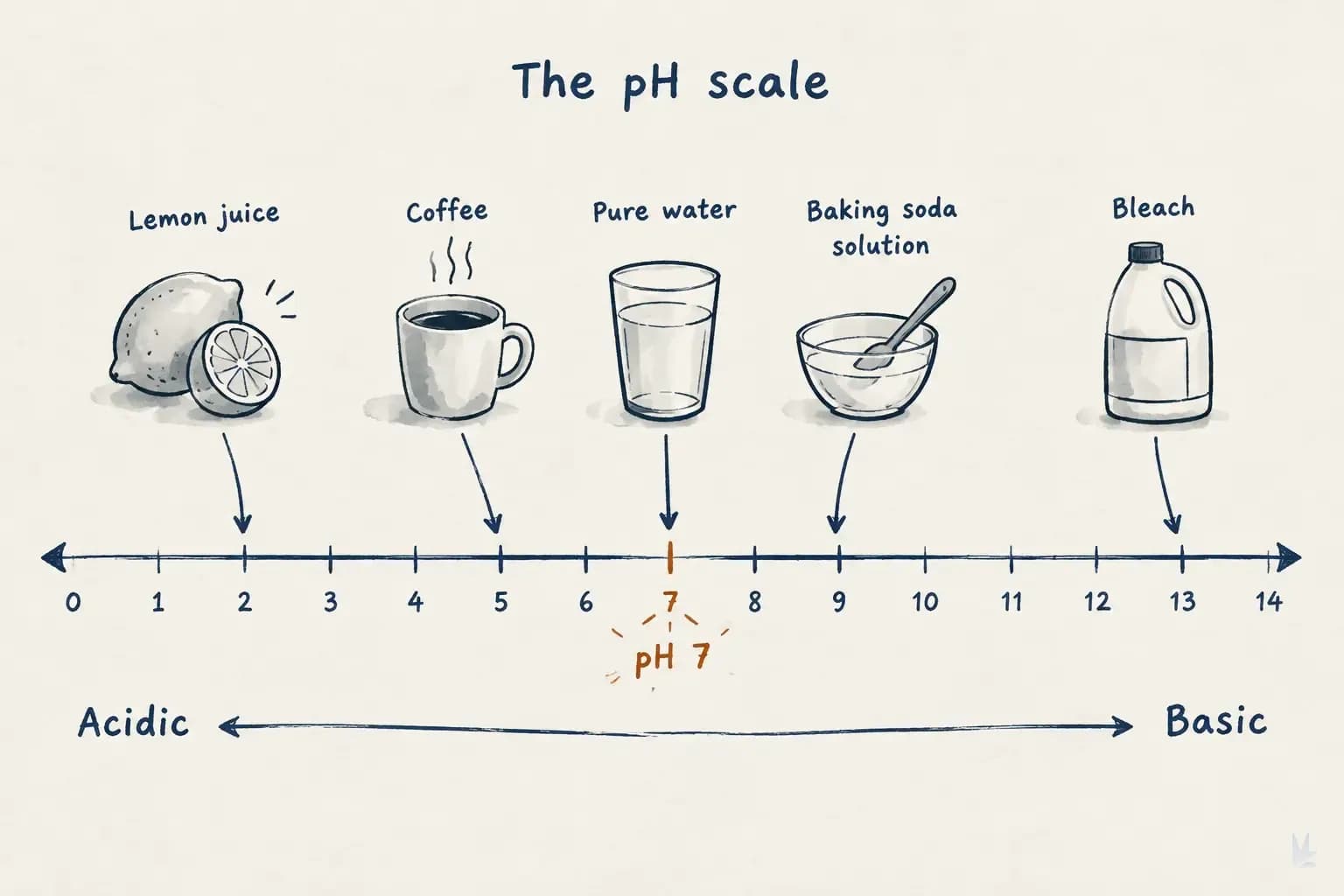
The pH scale from acidic lemon juice to basic bleach.
pH quietly shapes the food you eat, the products you clean with, and even the water you swim in. Once you know where to look, you’ll start noticing it in almost every room of your home.
Tomatoes, citrus, and soda are acidic, which is why they taste tart and why acidic drinks can wear on tooth enamel over time. Cleaning products use pH on purpose. Acidic cleaners dissolve mineral deposits like limescale, while basic ones break down grease and grime.
Healthy skin is slightly acidic, around 4.5 to 5.5, which is why many soaps and shampoos advertise a pH balanced formula. Pools are kept near 7.2 to 7.8 so swimmers stay comfortable and chlorine works properly. Aquarium fish are even pickier, since a sudden swing in water pH can stress or harm them.
Start with labels. Many skin and hair products state their pH, and household cleaners warn you when they are strongly acidic or basic. Never mix products that sit at opposite ends. Bleach with an acidic cleaner can release toxic gas.
For testing at home, pick up pH test strips. Dip one in your sample, compare its color to the chart, and you have a reading in seconds. Digital meters are more precise but need regular calibration.
Next time you open a cupboard, pick three products and guess their pH before you check the labels. That small game builds the intuition faster than memorizing any chart.