Hide outline
Share Blog
Blog
Author:
Was this lesson helpful?
Dive Deeper
Generate a follow-up sub-lesson on any aspect of this topic
Ikigai is a Japanese word for what makes life feel worth living. It is a daily sense of purpose, not a career answer, and this guide covers its origins, the Venn diagram myth, real examples, and a simple way to find yours.
Ikigai means a reason for living, the thing that gets you out of bed and gives an ordinary day some weight. It can be as large as raising a child or as small as a morning coffee on the balcony. The meaning of ikigai is closer to a feeling of purpose in everyday life than a grand mission statement.
Ikigai combines iki, meaning life or living, with gai, which traces back to kai, an old word for shell and, by extension, value or worth. Put together, it points to the value found in being alive. Japanese speakers use it casually, asking what someone’s ikigai is much as we might ask what keeps them going.
Translation is where it gets slippery. English offers purpose, passion, meaning, and fulfillment, and none fits cleanly. Ikigai carries no pressure to be impressive or profitable, and it can be quiet, private, and even modest.
The well-known diagram shows four overlapping circles for what you love, what you are good at, what the world needs, and what you can be paid for. Ikigai sits at the center. It is appealing, but it came from Western discussions of purpose and career, not from Japanese tradition.
The diagram’s biggest problem is the pay circle. Japanese research on ikigai describes it as something that can exist with no income attached. Treating it as a job-finding formula leaves many people feeling they have failed when they cannot match all four circles.
Pay is optionalIkigai does not need to be your profession. Many people find it in family, hobbies, or community.
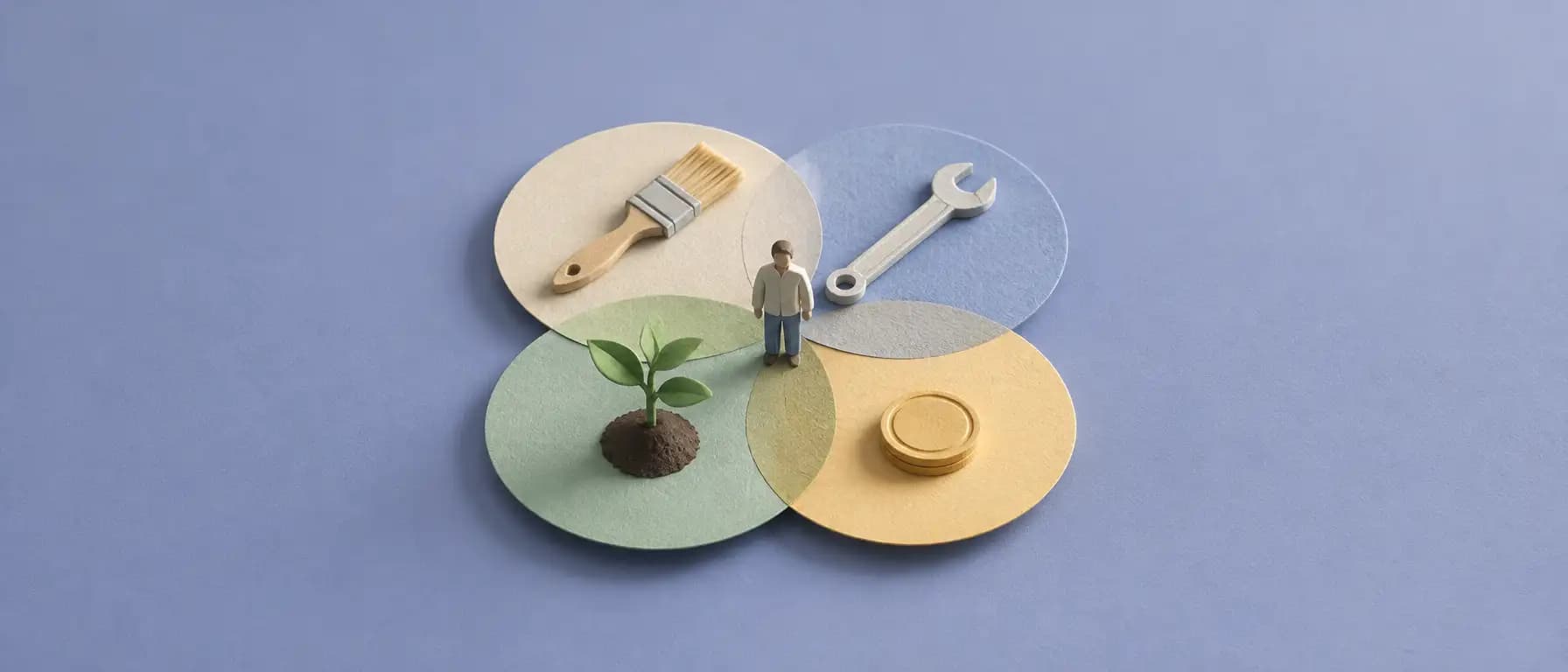
The popular four-circle diagram is one way to picture ikigai, not the whole idea.
In practice, ikigai tends to be unremarkable and specific. A retired man tends his vegetable plot. A nurse feels useful on a hard shift. A grandmother cooks for the family every Sunday. What these have in common is a small, repeatable source of meaning.

Ikigai is often small and specific, like a garden tended every morning.
Start with reflection rather than a big decision. Ask yourself what you lose track of time doing, who you feel useful to, what you would miss if it disappeared, and what small thing you looked forward to this week. Write short answers and look for repeats, since patterns reveal more than any single response.
Then run a simple weekly experiment. Pick one activity from your list and give it a set time over the next seven days, such as 30 minutes on Saturday morning. Afterward, note how you felt before, during, and after. Keep what energizes you, drop what does not, and try another next week.
Ikigai is not a destination you reach once and file away. It shifts as your life does, and it can be several things at once. Some seasons it lives at work, and in others it lives at home or in a garden.
Choose one small thing this week that feels worth doing for its own sake, and do it on purpose. That is ikigai in action, and it counts.