Hide outline
Share Blog
Blog
Author:
Was this lesson helpful?
Dive Deeper
Generate a follow-up sub-lesson on any aspect of this topic
Learn to write a project charter that sponsors sign quickly. Cover purpose, scope, stakeholders, milestones, risks, and approval language, then reuse a copy-paste template for every future project.
A project charter is the short document that authorizes a project and gives the project manager the right to spend money and pull people in. Write it before planning starts, once a sponsor agrees the problem is worth solving. A good one fits on two pages, answers what, why, who, and how much, and leaves a sponsor with nothing to guess about.
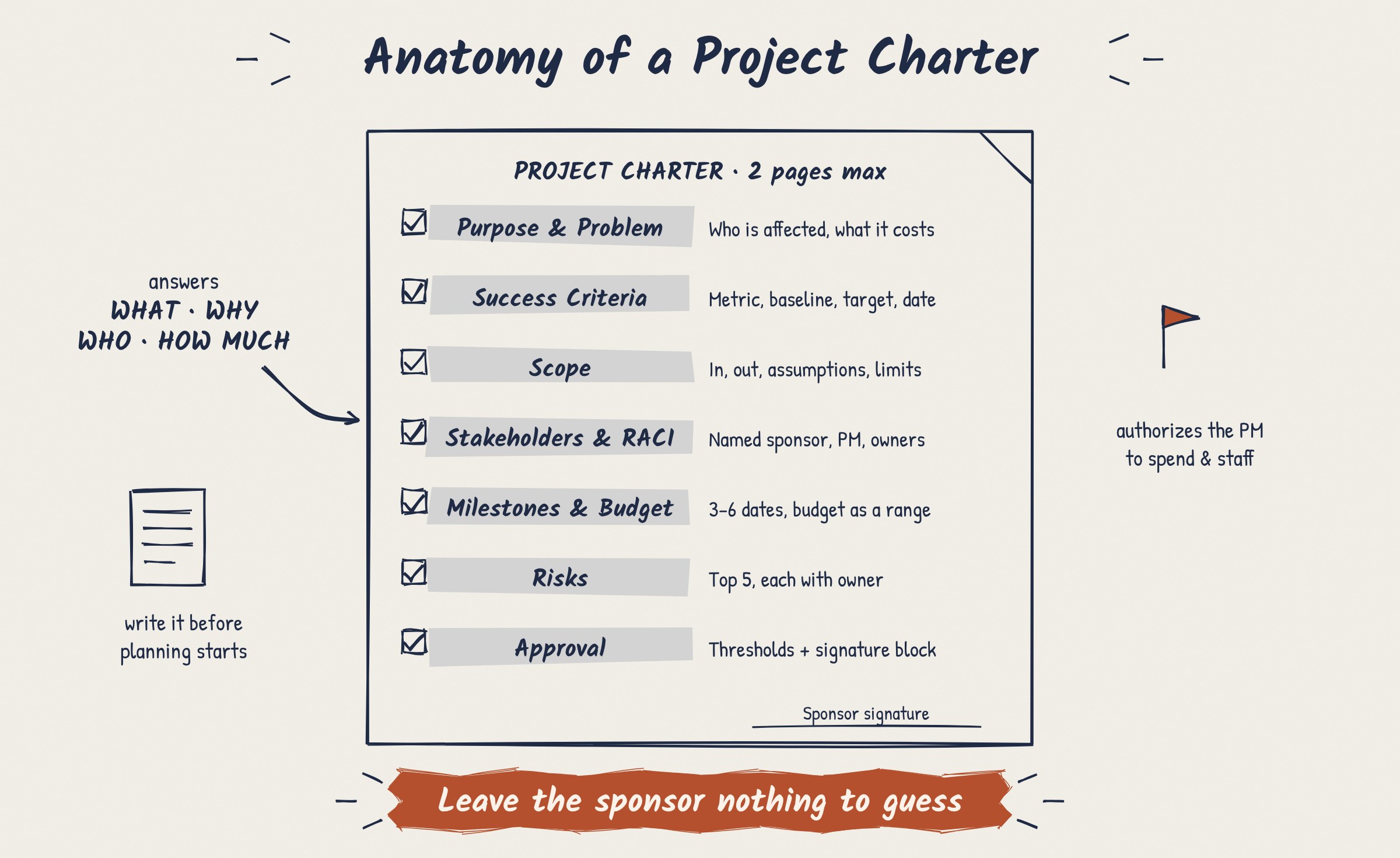
Anatomy of a project charter: purpose and problem, success criteria, scope, stakeholders and RACI, milestones and budget, risks, and approval, all on two pages that answer what, why, who, and how much.
Start with the problem, not the solution. A clear problem statement names who is affected, what it costs, and how you know. “Order approvals stall for 4.5 days on average, costing roughly 120 support hours a month” is far stronger than “the approval process needs improving.”
Then convert intent into success criteria a stranger could verify. Each one needs a metric, a baseline, a target, and a date. If you cannot measure it, the sponsor cannot confirm you delivered it.
Measure or drop Any success criterion without a baseline and a target date is a wish. Rewrite it or remove it.
Scope is where most charters are won or lost, because it is where expectations quietly diverge. State what is in scope, and be just as explicit about what is out. The out-of-scope list prevents more arguments than any other paragraph you will write.
Close the section with a single line on change control, the agreed route for altering scope, such as written requests reviewed by the sponsor within five working days. Without it, scope creep arrives as friendly favors.
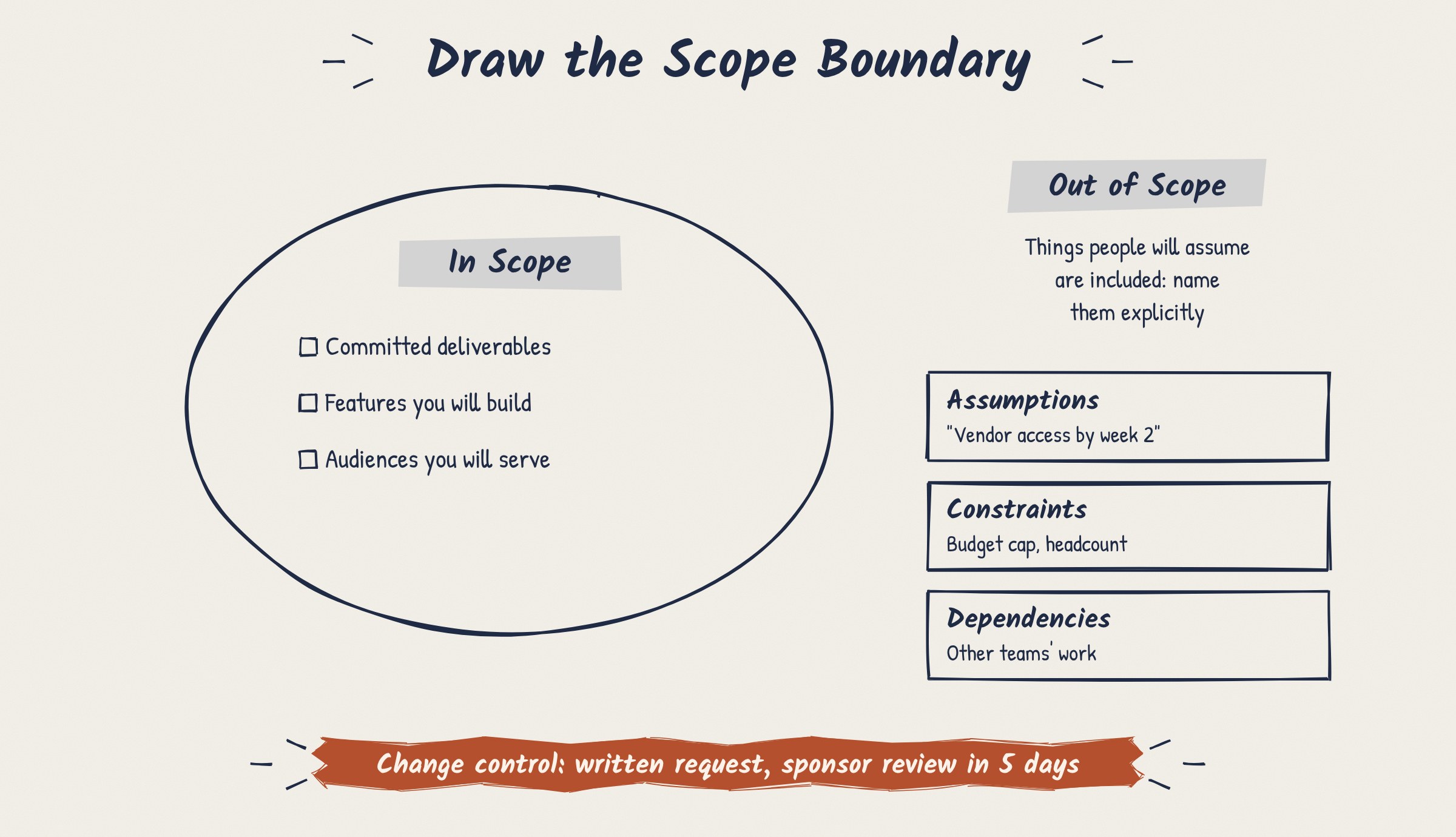
Draw the scope boundary: list what is in scope, name what is out of scope, record assumptions, constraints, and dependencies, and agree on a change control route.
Name people, not departments. The sponsor funds the project and clears obstacles, the project manager runs delivery, and the steering group decides when trade-offs exceed the PM’s authority. Write down who can approve spend, who can change scope, and who can stop the project.
A RACI table keeps this tidy, marking each key decision as Responsible, Accountable, Consulted, or Informed. Keep exactly one Accountable person per decision, since two owners means none.
Add an escalation path with time limits. For example, unresolved issues go to the sponsor after two business days, and to the steering group after five. Sponsors approve charters that show how problems will reach them early.
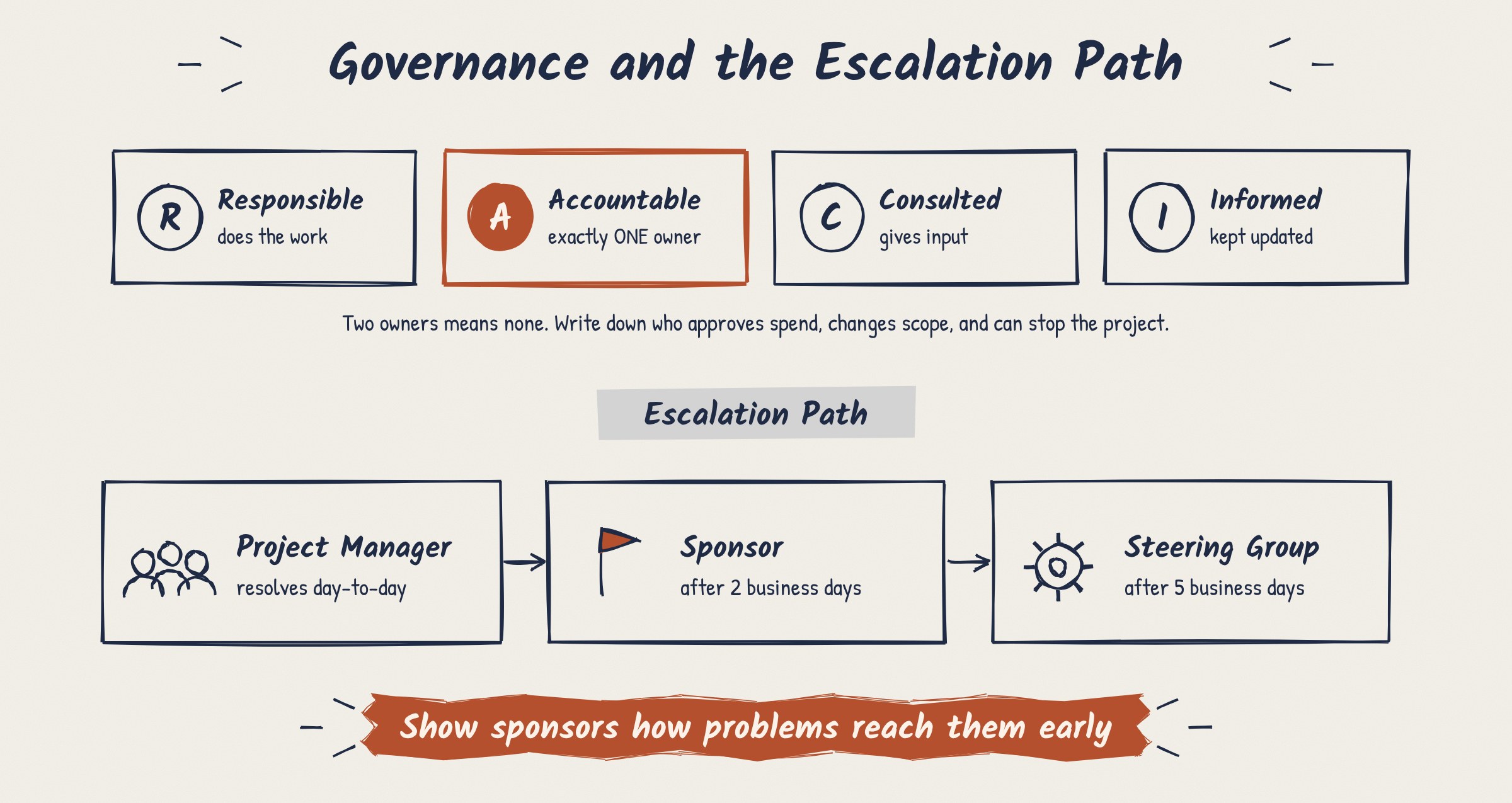
Governance at a glance: RACI roles with exactly one Accountable owner per decision, and an escalation path from project manager to sponsor after 2 business days and to the steering group after 5.
Keep the plan high level. List three to six key deliverables with target dates, plus checkpoints where the sponsor can review progress and decide to continue, adjust, or stop. Detailed schedules belong in the project plan, not here.
| Element | What to include | Example |
|---|---|---|
| Milestone | Deliverable and date | Pilot live, 14 March |
| Budget | Range, not a point | $80k to $100k |
| Resourcing | Roles and allocation | 1 PM, 2 engineers at 50% |
Give budget as a range and state its confidence level. A single figure invites a debate over a number you cannot yet defend, while a range with stated assumptions reads as honest and gets approved faster.
List the top five risks at most, each with likelihood, impact, an owner, and a mitigation. Sponsors read this section to judge whether you have thought ahead, so favor specific risks like “a key engineer leaves mid-project” over generic ones like “resource issues.”
Define acceptance thresholds too, meaning the conditions under which the project counts as done. Then end with approval text that is easy to sign. For example: “By signing, I authorize this project, the stated budget range, and the named project manager to proceed under the governance above.” Add name, role, signature, and date lines for each approver.
Copy this structure and answer each prompt in one or two sentences.
Fill it in for your next project, send it to the sponsor with a thirty-minute review slot, and treat their questions as edits to make, not objections to fight.